
How Much Does It Cost to Build a Web Application for a Business?
There is no single price for building a web application. Features, user roles, permissions, integrations, UX and infrastructure can significantly change the scope. This guide explains what affects development cost and how to plan a focused first version.
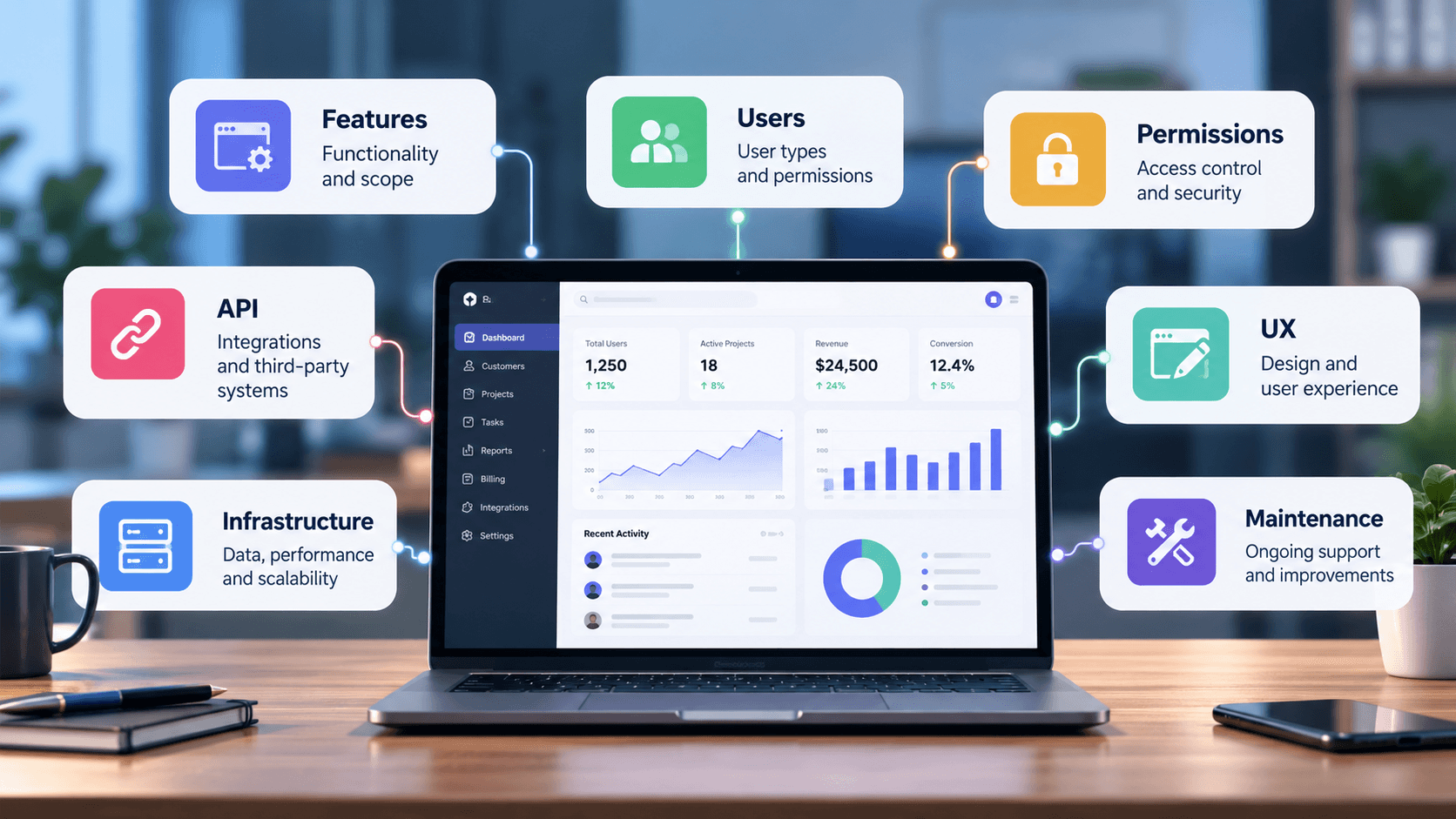
“How much does it cost to build a web application?” sounds like a simple question, but there is no single price that applies to every project.
An internal tool used by a few employees is very different from a platform with multiple user roles, permissions, payments, notifications, reports and third-party integrations.
A reliable estimate should therefore begin with what the system needs to do, who will use it and what must be included in the first version.
This guide explains the main factors that affect web application development cost, what usually increases the scope and how to avoid building functionality that is not yet necessary.
What is a web application?
A web application is software that runs through a browser and performs business processes or user actions beyond simply displaying content.
Examples include:
- Customer and lead management systems
- Customer portals
- Booking and scheduling platforms
- Internal business tools
- Management dashboards
- SaaS platforms
- Marketplaces
- Systems with automation and integrations
If your business requires a workflow that cannot be handled properly by an off-the-shelf product, custom web application development may be worth considering.
So how much does a web application cost?
The range can be very wide, which is why a generic price found online rarely tells you what your own project will cost.
A focused system with one main process and a small number of users is very different from a platform with several user types, complex permissions, APIs, payments, reporting, notifications and infrastructure designed to scale.
The more useful question is:
What actually needs to be built for the application to solve the business problem?
7 factors that affect web application development cost
1. Feature scope
The more processes and actions the application needs to support, the larger the development scope becomes.
Counting screens is usually not enough. One screen may simply display information, while another may include search, filtering, permissions, calculations, documents, notifications and activity history.
2. User roles and permissions
A system where every user has the same access is simpler than a platform with administrators, employees, customers and suppliers who each have different permissions.
Permissions need to be handled both in the interface and on the server, which affects development and testing.
3. APIs and integrations
Does the system need to connect to a CRM, payment provider, WhatsApp, accounting software, email platform or another external service?
Each integration adds another layer to the project. Some APIs are straightforward, while others may be limited, poorly documented or connected to older systems.
If the main goal is to make existing tools work together rather than build a new product, business automation and system integration may be the better option.
4. UX and interface complexity
An internal application used by a small team can often work well with a focused, functional interface.
A customer-facing product usually requires more work on mobile behaviour, onboarding, navigation, error states and user experience.
5. Data, performance and usage
A system used by ten employees does not necessarily require the same architecture as one designed for thousands of users.
Large datasets, frequent operations, reporting, search, file uploads and resource-intensive processes can affect both architecture and development effort.
6. Security and sensitive data
Systems that store sensitive business or customer information require additional attention to authentication, permissions, data handling and access control.
7. How production-ready the first version needs to be
There is a difference between an early prototype used to test an idea and a system a business depends on every day.
A production application usually requires more testing, handling of edge cases, monitoring, backups and maintainable architecture.
Why the number of screens does not determine the price
Imagine two systems that both include a “Customers” screen.
In one application it only displays a name and phone number.
In another it includes:
- Search and filtering
- Status management
- Activity history
- Documents
- Role-based permissions
- Notifications
- CRM integration
- Reporting
They may both appear to contain one screen, but they represent very different development projects.
How can you reduce development cost?
Start with the problem, not a feature list
Before deciding what to build, describe what is not working today.
For example: “We manage orders across three spreadsheets and cannot easily see the status of each order.”
This makes it easier to design a solution around the real business problem.
Define a focused first version
Not every idea needs to be included in version one.
Separate what the product must have in order to be useful from features that can wait until later.
For a new product that still needs market validation, it may be better to begin with a focused MVP.
Do not rebuild functionality that already exists
Sometimes an existing service, API or third-party platform already solves part of the problem.
Integrating with it can make more sense than building the same functionality from scratch.
Build in stages
Splitting a project into stages can reduce risk and make budgeting easier.
The business can start using the system, learn what is actually missing and then decide what should be developed next.
What costs can continue after development?
Development is not always the only cost.
Depending on the application, ongoing expenses may include:
- Hosting and servers
- Database services
- Third-party platforms
- Paid APIs
- SMS or messaging services
- Email delivery
- Payment processing
- File storage
- Maintenance and future improvements
It is useful to understand which costs are one-time and which continue after launch.
Fixed price or development in stages?
There is no single model that fits every project.
When requirements are clear and the scope is well defined, a project or development phase can often be estimated in advance.
For complex products, existing codebases or requirements that are still evolving, a phased approach can reduce uncertainty.
The important thing is to understand what is included, what is outside the agreed scope and how changes are handled.
What if the system already exists?
An existing application that has become difficult to maintain does not automatically need to be rebuilt from scratch.
In many cases, legacy system modernization can improve the problematic parts while preserving functionality that already works.
What should you prepare before asking for an estimate?
You do not need a fifty-page specification document.
Start by answering five questions:
- What problem should the system solve?
- Who will use it?
- What are the three most important actions users need to perform?
- Which existing systems must it connect to?
- What must be included in the first version and what can wait?
The clearer these answers are, the easier it becomes to estimate the real scope of the project.
The bottom line
There is no universal price for a web application because no two applications have exactly the same workflows, users and integrations.
The right way to estimate development cost is to first define the business problem, users and the first version that actually needs to be built.
A good system is not the one with the most features. It is the one that solves the right process and can be used, maintained and improved over time.
If you already have an idea, a manual business process or an existing workflow that needs a better system, you can start by discussing the scope of a custom web application before deciding how much needs to be built.